An Option for Pickleball Doubles' Leagues
While there are a bunch of doubles' league formats, I think the most common are:
- Ladder Leagues where players register as individuals;
- Ladder Leagues where players register and play as teams;
- Round Robin Leagues where players register as individuals; and
- Round Robin Leagues where players register as teams.
I suspect most folks registering for league play hope everyone in the league plays at about the same level, and they'll have a reasonable chance to win the league.
Typical ladder league play has a players moving up or down the ladder based on their skill level, which meets the expectation of having people play at about the same level.
If 32 players register for ladder league play as individuals, only one person will be able to win the league. If players register as a team, only two players will be able to win the league. And in many ladder leagues, most of the players do not have a realistic chance of winning the league because they aren't anywhere near as skilled as the players at the top of the ladder.
Typical round robin league play might have 8 players in a league. If 32 players register for that type of league play, there would be 4 leagues. If those players register as individuals, there would be 4 league winners. If those players register as teams, there would be 8 league winners. In either format, a larger number of the 32 players would have a chance to win their league than if they were in a 32 player ladder league.
The fly in the ointment with this type of play is that very few recreational pickleball players have an accurate assessment of their skill level. In recreational pickleball leagues, it is very common to have players either much more skilled or much less skilled than the other players in their league. One way to address that would be having a 11 week long session where the first 4 weeks of play evaluates players' skill levels and places them in 8 player leagues based on their playing ability. The remaining 7 weeks of play has each 8 player league play in a standard round robin format.
11-Week Pickleball Round-Robin Doubles Leagues with Rotating Partners
This league format:
- Accepts players of all skill levels;
- Allows participants to play with players of similar skill levels;
- Gives most players a reasonable chance to win their league;
- Once set up, operates with minimal effort on the part of the league administrators
- Accommodates any number of players that is a multiple of 8.
Here's How It Works:
Let's say Brent wants to play in a Wednesday night pickleball league. When he visits the Park District web site to sign up for league play, the registration form asks for his numerical pickleball skill level. Brent doesn't have a DUPR rating or a USAP rating, so he consults a Pickleball Self-Rating Worksheet, decides his rating is 4.20, and enters that rating on the registration form.
Behind the scenes, Brent and everyone else who registered for league play is placed in a single list that either a spreadsheet or some computer app sorts by the players' reported numerical skill rating. This example uses a list of 32 players, but the number of participants can be any multiple of 8 players, limited only by court availability.
Still behind the scenes, the spreadsheet or computer app separates the players in the list into groups of 4 players.
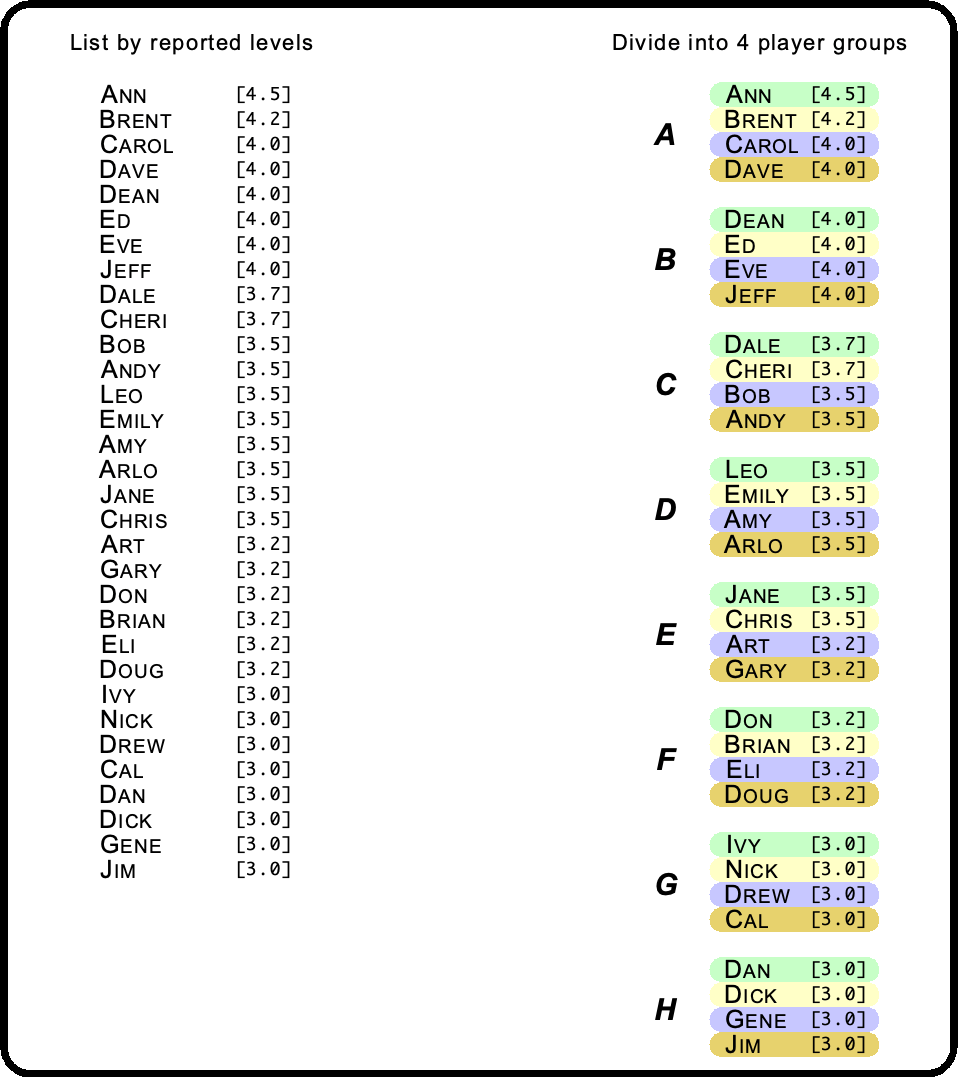
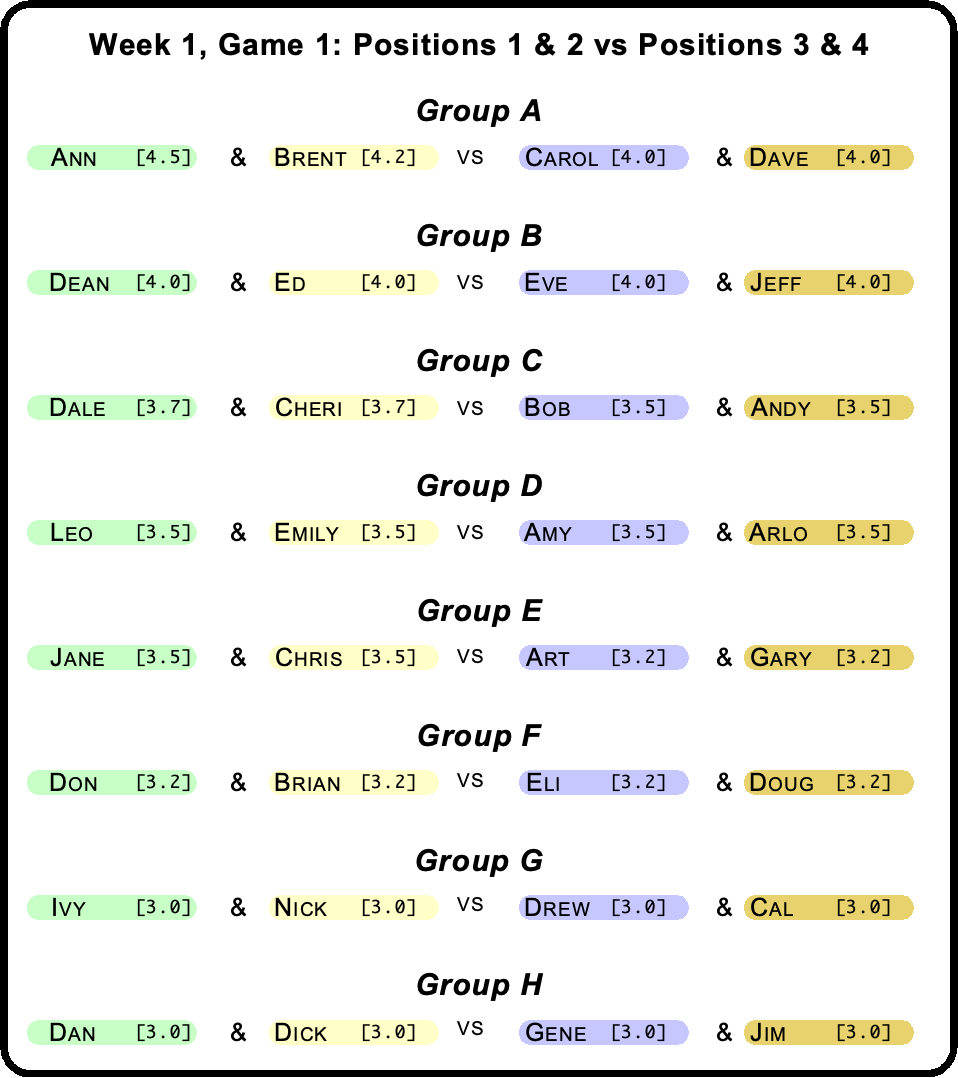
Shortly before the league starts, Brent receives an email telling him everyone has been placed in 4-player groups, and the first 4 weeks of the league will have 4-player round-robin doubles tournaments to help seed everyone by their playing ability. For week 1's tournament, Brent is in Position 2 of Group A.
In game 1 of the tournament, players in positions 1 & 2 of each group play against the players in positions 3 & 4 of their group. In this example, Brent will partner with Ann and play an 11 point game against Carol and Dave:
At the end of the game, one of the players grabs their smart phone and logs into a score-keeping web site to record both the game score and the house number of a player on the other team who approves the recorded score. In Brent's game, Carol reports the score and Brent tells Carol his house number so the system knows Brent approves the entry.
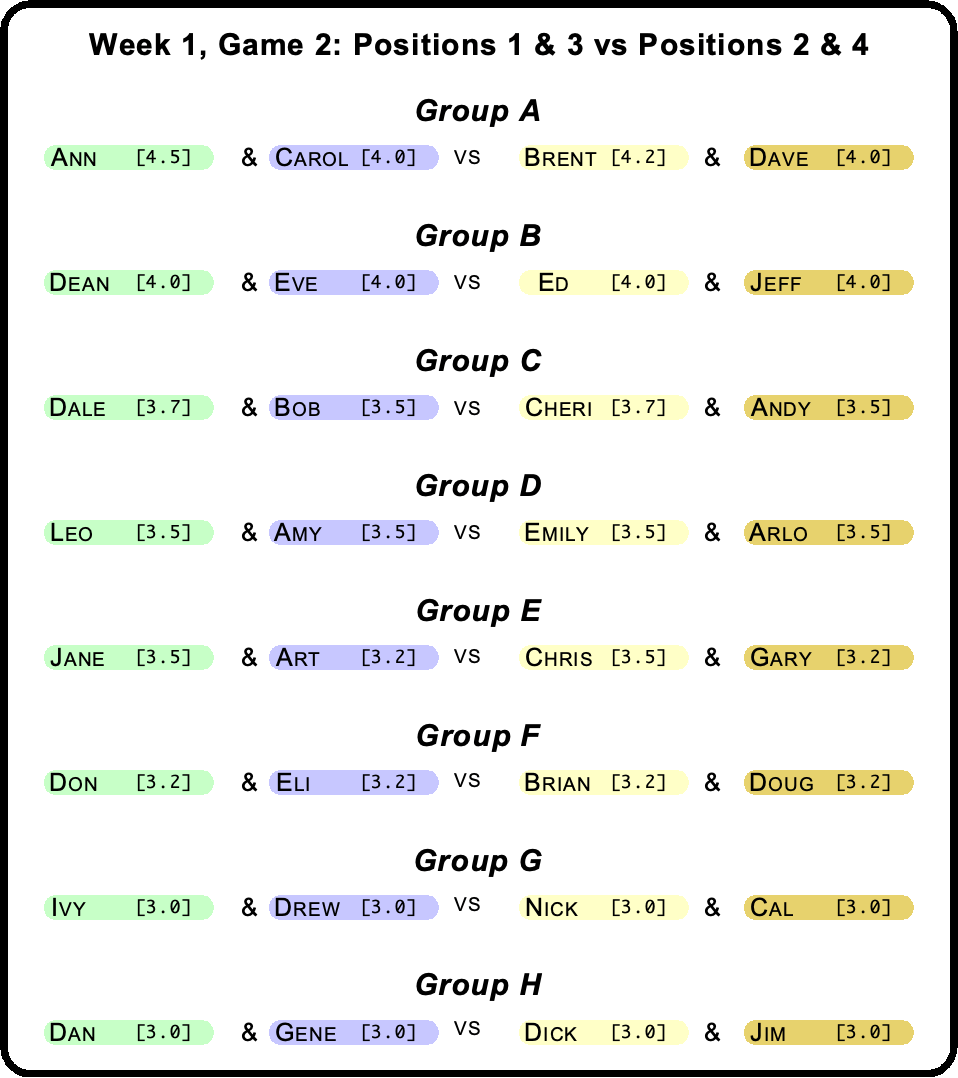
In game 2 of the tournament, players in each group's positions 1 & 3 play against the players in their group's positions 2 & 4. In this example, Brent and Dave play against Ann and Carol:
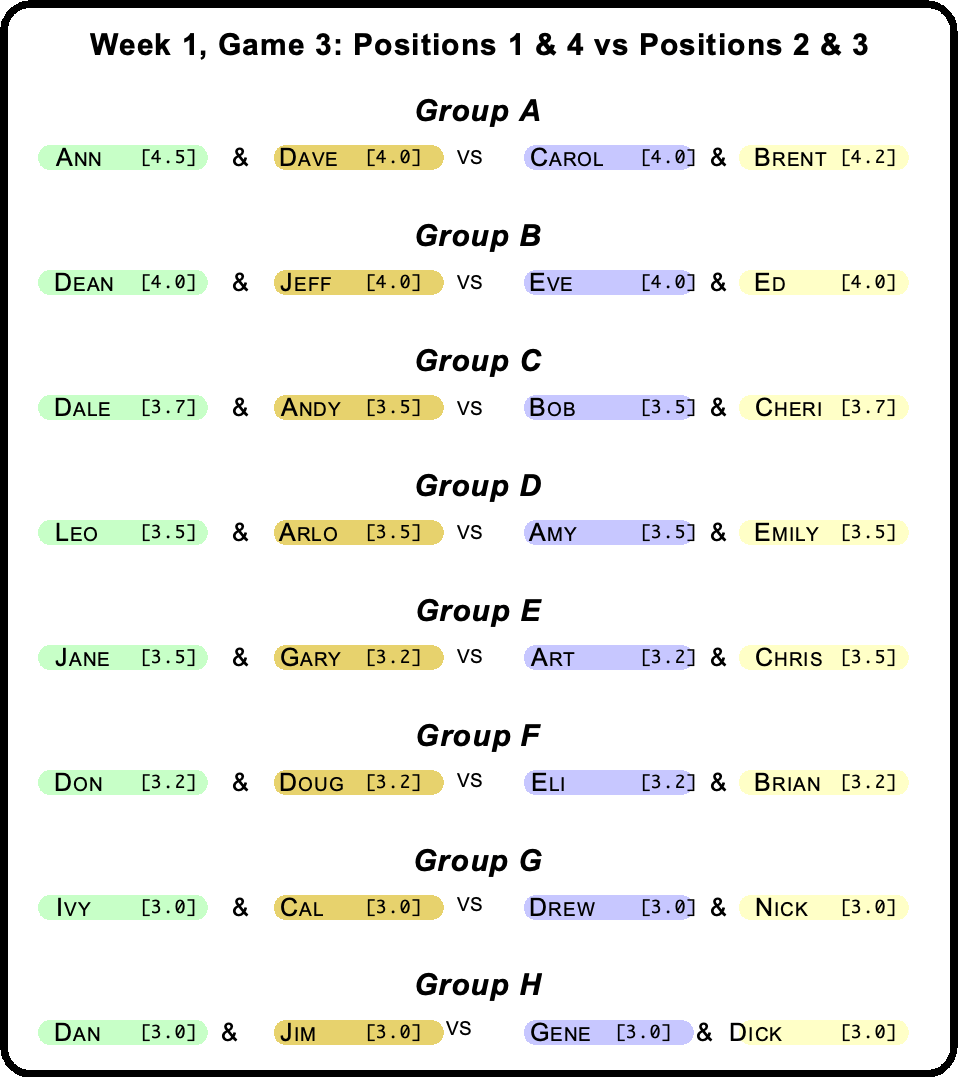
As you've probably guessed, after recording game 2's score, players in each group's positions 1 & 4 play a game against the players in their group's positions 2 & 3. So Brent and Carol play Ann and Dave:
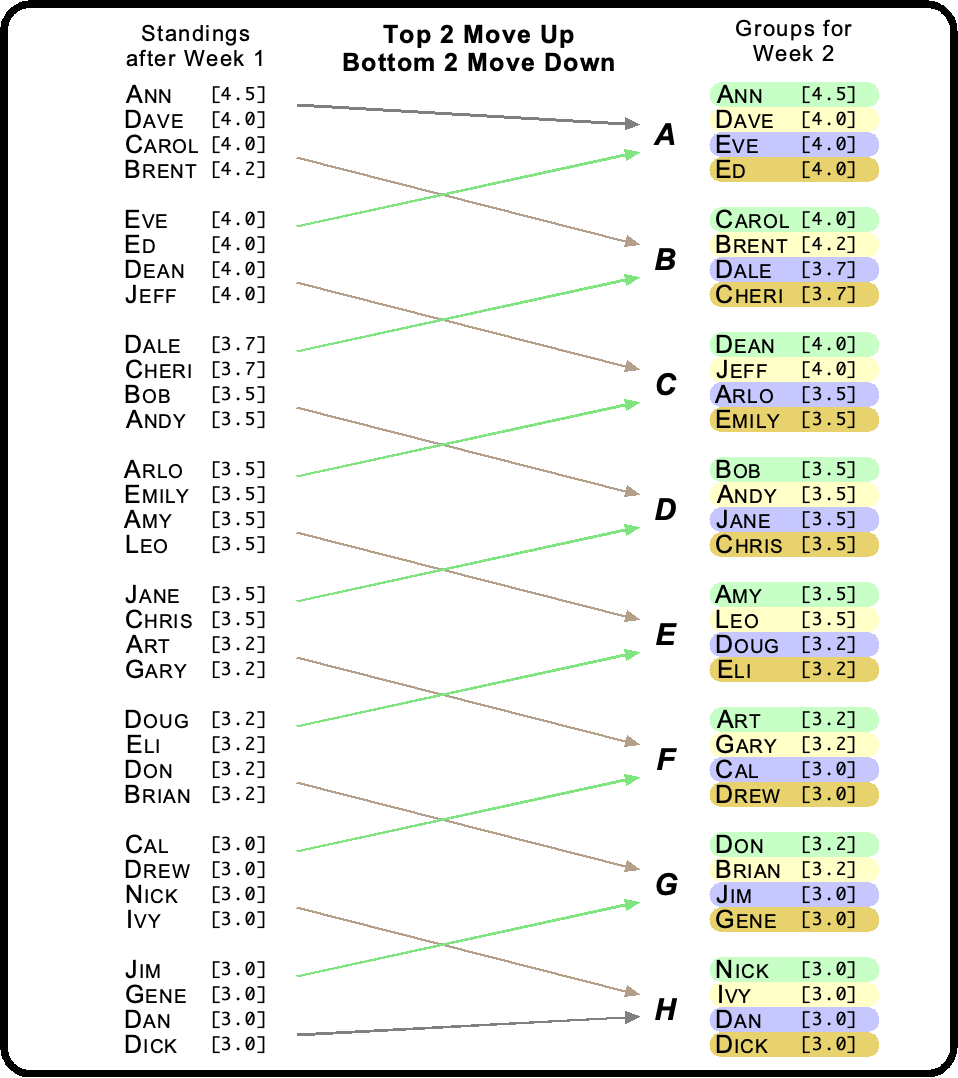
At the end of week 1 play, the spreadsheet or computer app re-sorts the list of players, moving players in each group into the position that matches their finish in their group's week 1 tournament. Brent lost all 3 of his games, which places him in position 4 of Group A.
When the re-sorting is complete, the spreadsheet or app moves the top 2 players in each group up a group and the bottom two players in each group down a group. Brent moves from Group A to Group B.
Before the week 2 session, Brent receives an email telling him the court number and starting time for the next 3-game round robin doubles tournament.
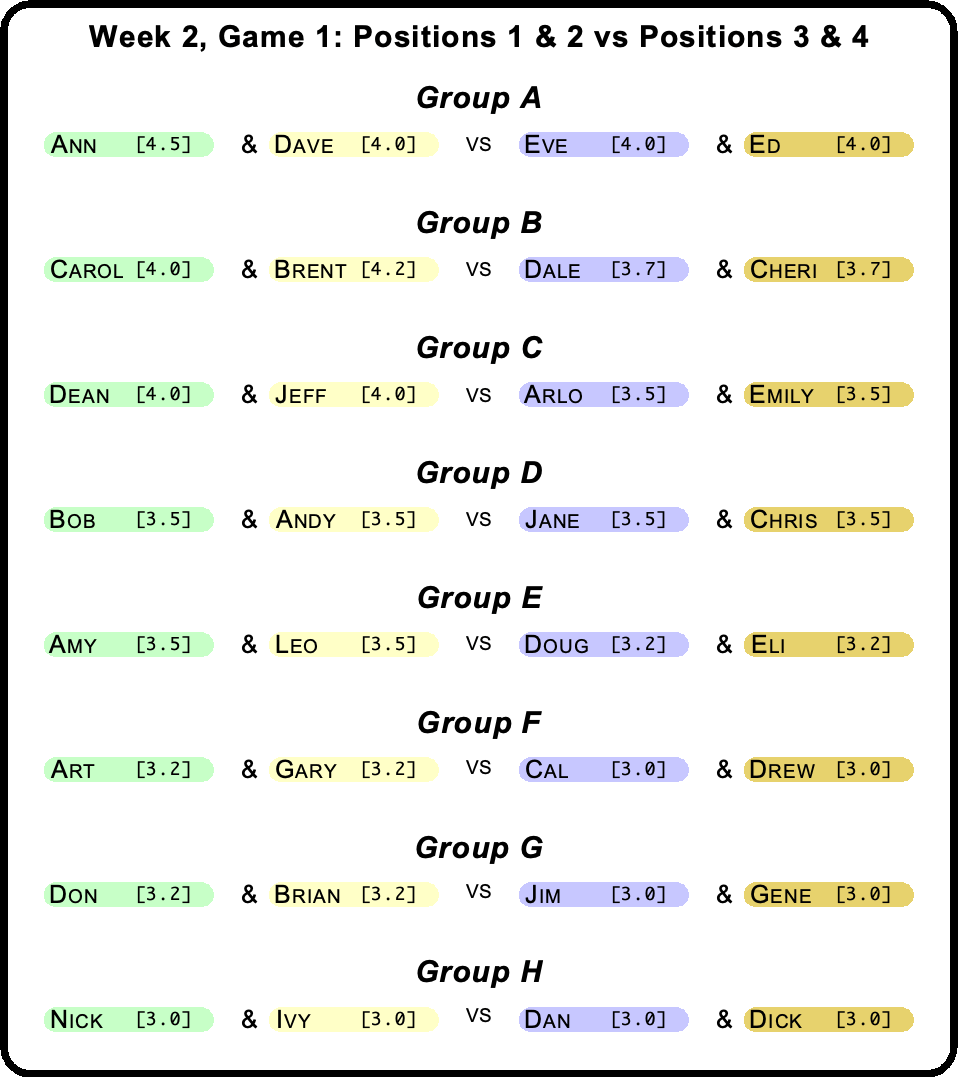
Game 1 of this second tournament has the players in positions 1 & 2 playing against the players in positions 3 & 4, so in Group B, Brent and Carol play against Dale and Cheri:
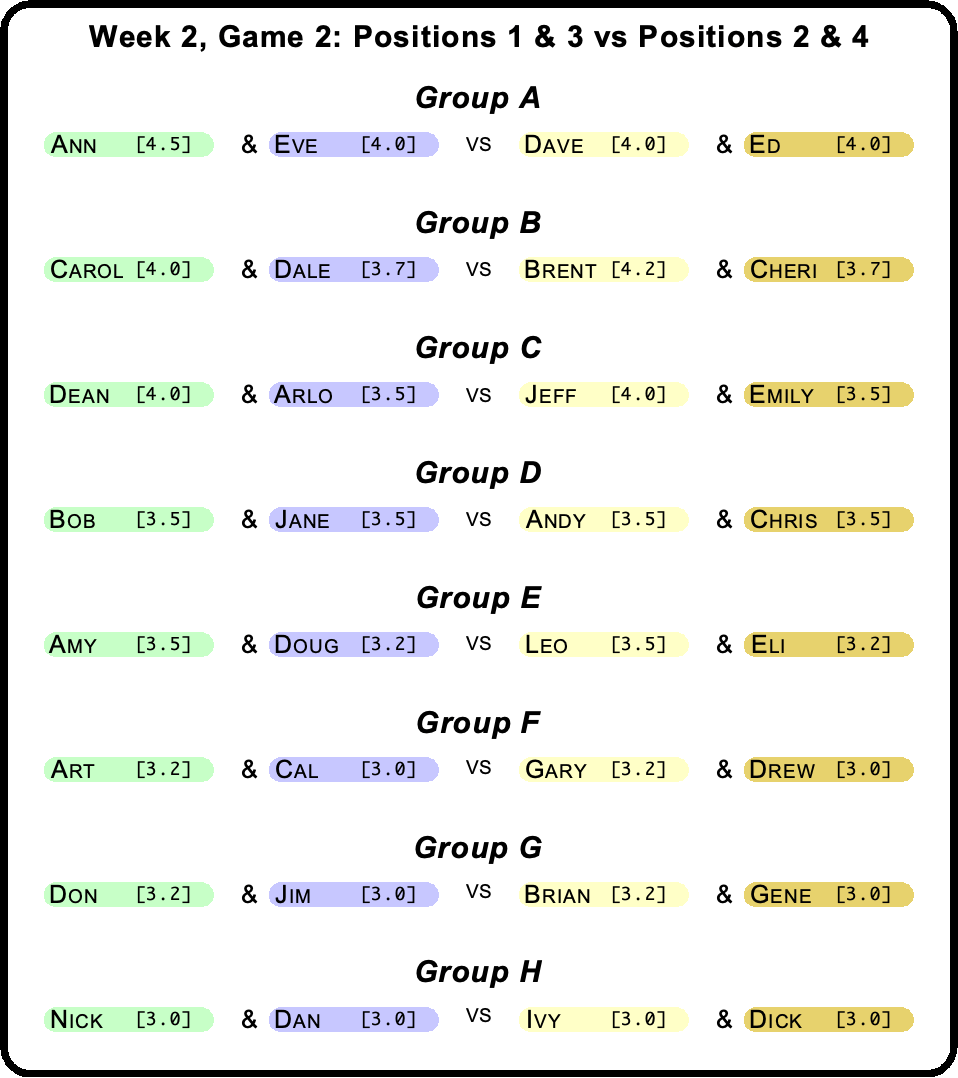
At the end of the game, one player uses their smart phone to report the score and record the house number of the player on the other team who confirms the score is correct. In game 2 of the second week, players in positions 1 & 3 play the players in positions 2 & 4, so Brent and Cheri play Carol and Dale:
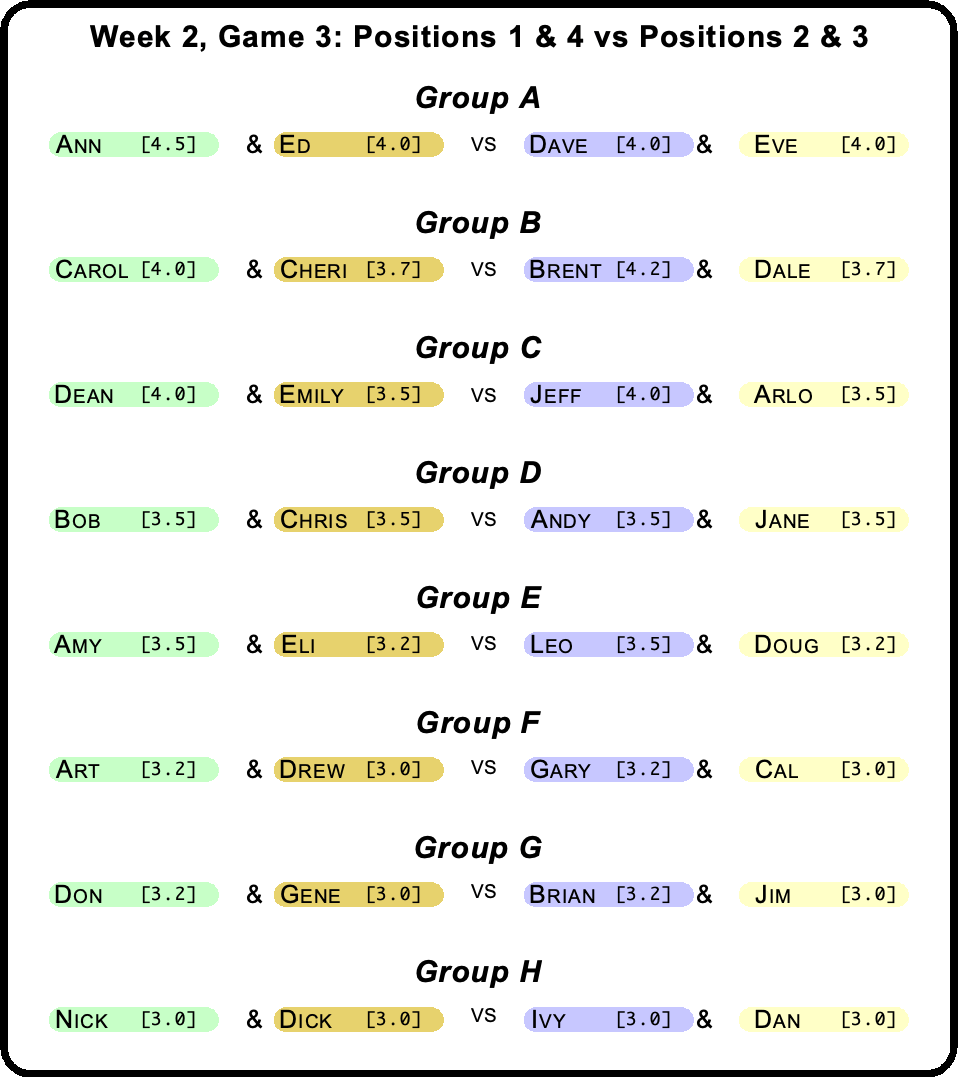
After reporting game 2's score, players in positions 1 & 4 play the players in positions 2 & 3. Brent and Dale play Carol and Cheri:
As happened after the first week's play, the spreadsheet or computer app re-sorts the list of players, moving players in each group into the position that matches their finish in their group's tournament. Brent finished next-to-last in his group, which places him in position 3 of Group B.
And then, once again, the spreadsheet or app moves the top 2 players in each group up a group and the bottom two players in each group down a group. Brent moves from Group B to Group C:
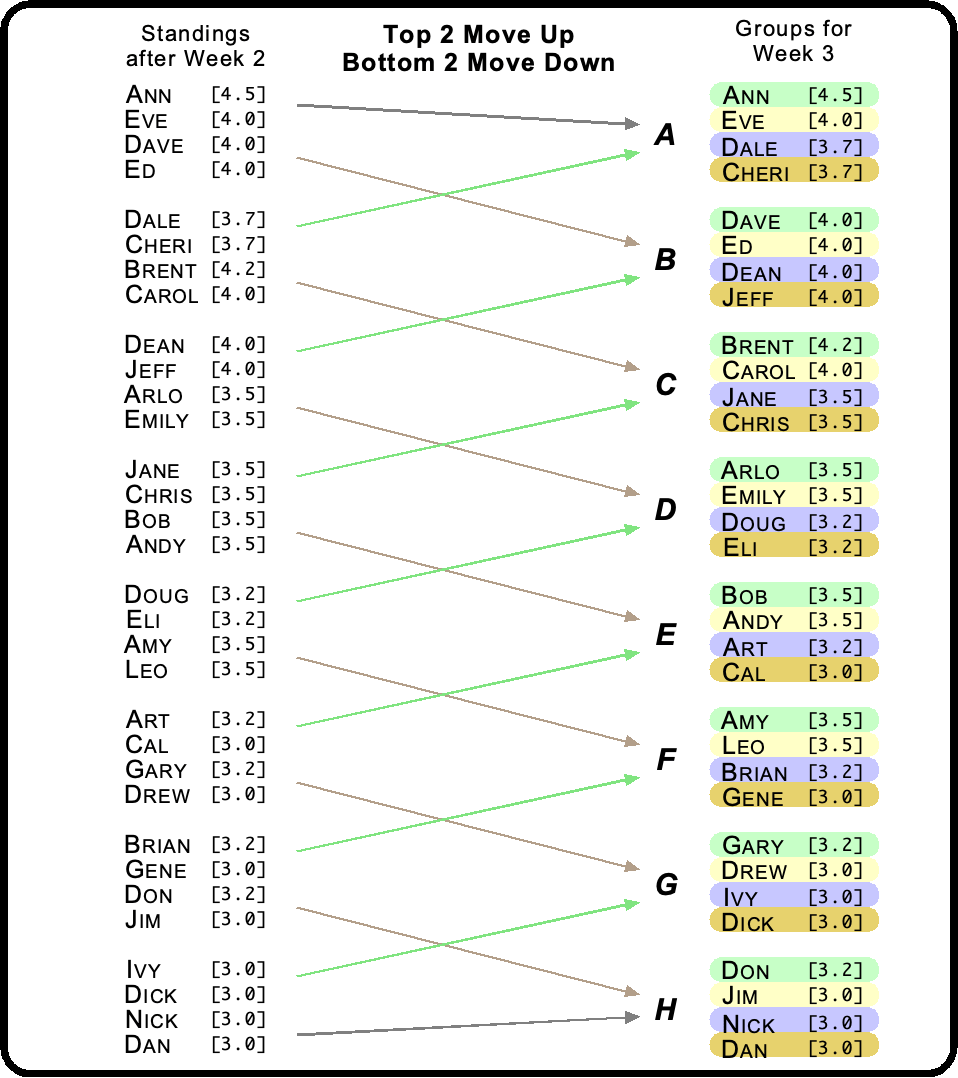
Week 3 has the another round of tournaments, after which players are re-sorted in their groups to match the tournament standings. And then the top 2 players in each group are moved up a group and the bottom 2 players in each group are moved down a group.
At the end of the 3 tournaments, Brent has moved from Position 2 in Group A to Position 1 of Group D.

Week 4 will have the final seeding tournament, after which players are re-sorted and moved to appropriate groups.
Switching from 4-player groups to 8-player groups forms a series of 8-player round robin doubles leagues where players should have similar playing abilities.
At this point, the league organizers have the option of adjusting any player's position based on their performance during the 4 weeks of tournaments. If, for example, a player scores a total of only 3 or 4 points in their week 4 play, the tournament organizers might move the player down one 8-player group. Or, on the other end, if a player started in Group E, F, G, or H and won all of their games, the organizers might move them up one 8-player group.
To show how the 4-week "seeding" process might move players into more appropriate groups in this example, the names printed in red text are players who ended up in a different 4-player groups than if the leagues had used only the players' reported skill level to form 4-player groups.

Each 8-player league then does 7 weeks of round-robin doubles play where everyone plays a 3-game match each week, rotating partners on a weekly basis.
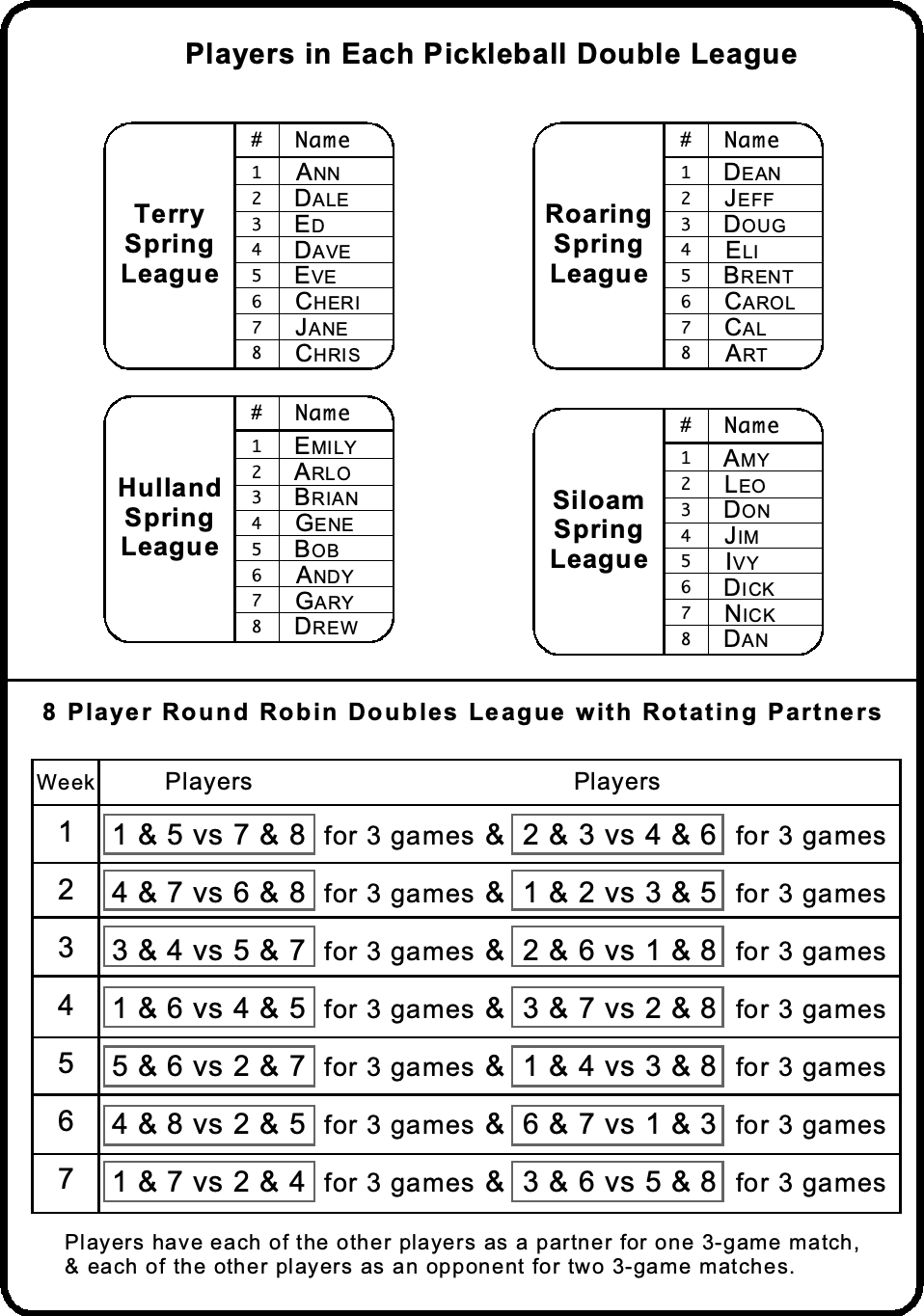
Scores are reported through the score-keeping app after each game and standings in each 8-player league are determined by the number of matches won during the 7 weeks of league play. The first tie-breaker is number of games won, the second tie-breaker is number of points allowed, and the third tie-breaker is random selection.
A Few Notes
The total number of participants in this format must be a multiple of 8.
Players are responsible for getting subs for any games they might miss, and subs must complete a release form before playing.
If one player is not on the court within 5 minutes after when a game should start:
- The missing player's score for that game will be recorded as a 0-11 loss.
- The missing player's partner can either play "skinny" 1 vs the other 2 players to determine the scores to record for the 3 players at the courts on time, or recruit a sub from among any players who are at the facility and ready to play.
- Subs must have completed and signed a park district waiver before playing.
- If the missing player arrives late and is ready to play before a total of 4 points have been scored, any game in progress is abandoned, the scheduled doubles game is played, and scores for all 4 players are recorded as usual.
- If 4 or more total points have been scored before the late player is ready to play, the late player waits until the game is finished before joining in to play any remaining games in the match.
If two players are not on the court within 5 minutes after when the game should start:
- Both missing players' scores for that game are recorded as a 0-11 loss.
- The remaining players will either play a modified skinny singles game to determine what scores will be recorded for each of them, or recruit subs from any players at the facility who are ready to play.
- In the modified skinny singles game, each player's position at the time of serve is determined by their score. A player, regardless of whether serving or receiving, who has an even score will play on the right half of the court and a player who has an odd score will play on the left half of the court. This means there will be times when the players will oppose each other diagonally, and times when players will oppose each other straight on. The player serving continues to serve until either they reach 11 points or they lose a rally (there is no first server/second server).
All games are side-out scoring to 11 points, possibly with a win by 1 restriction (the first team to score 11 points wins).
This format requires 2 court hours per week for every 8 players registered, and if no play is cancelled due to bad weather, takes 11 weeks to complete. It might be worth considering planning for the 11 week league to run for 12 or 13 weeks in order to accommodate any rainouts. If 32 people register, league play each week would need a block of 4 courts for 2 hours or a block of 8 courts for 1 hour.
Because over 100 people have expressed an interest in league play, it might be worthwhile to consider having multiple league play sessions at different times and/or different days, allowing players to register for only one of the league sessions. For example, players could have the option of registering for a Wednesday session, a Thursday session, a Saturday session, Sunday session. If each of sessions have 32 registered players and players are allowed to participate in only one session at a time, there would be 128 people involved in league play. Each of those 4 sessions would need a block of 4 courts for a 2 hour time period, leaving the 4 remaining courts available for non-league play.
If league play is offered on multiple days or times, an option might be to stagger the start dates (and their associated registration deadlines). That would give players who miss the registration deadline for one session (Wednesday, for example) the option of registering for a different session (Thursday, for example).
Why This Format?
This format was devised because very few recreational pickleball players have an accurate numerical skill rating, and most of us who use some sort of self rating worksheet overestimate our playing abilities.
Lack of accurate skill levels typically isn't an issue in "recreational" pickleball play, because when a player in a recreational doubles game is much less skilled than the other players, the opposing team almost always quietly switches from playing competitively to playing cooperatively. Instead of playing in a manner they know is above the less-skilled player's ability, the more-skilled players will hold back and play at the less-skilled player's level.
But it is a different story in a league where the number of points the other team scores can affect a player's standing in the league. Playing cooperatively against a less-skilled opponent increase the chances of the less-skilled player's team scoring points. So to avoid losing any "points allowed" tie-breakers in league play, many teams will direct play at the less-skilled player, using shots and strategies they believe that player isn't capable of handling.
As you might imagine, when a team plays to a less-skilled player in this way, the games aren't a lot of fun for either the less-skilled player or that player's partner. I've seen games where, outside of hitting or returning serves, the most skilled player on the court had only 3 or 4 opportunities to hit the ball because the other team directed all their play at his less-skilled partner.
This kind of thing doesn't happen when everyone on the court has about the same skill level, so the problem with many leagues is the general lack of accurate skill level rating results in one or more people playing in a league where they become the "target" of any players who want to avoid losing "points allowed" tie-breakers.